User Panel

Training / Courses
Search

Nicole
Director of Finance and Administration
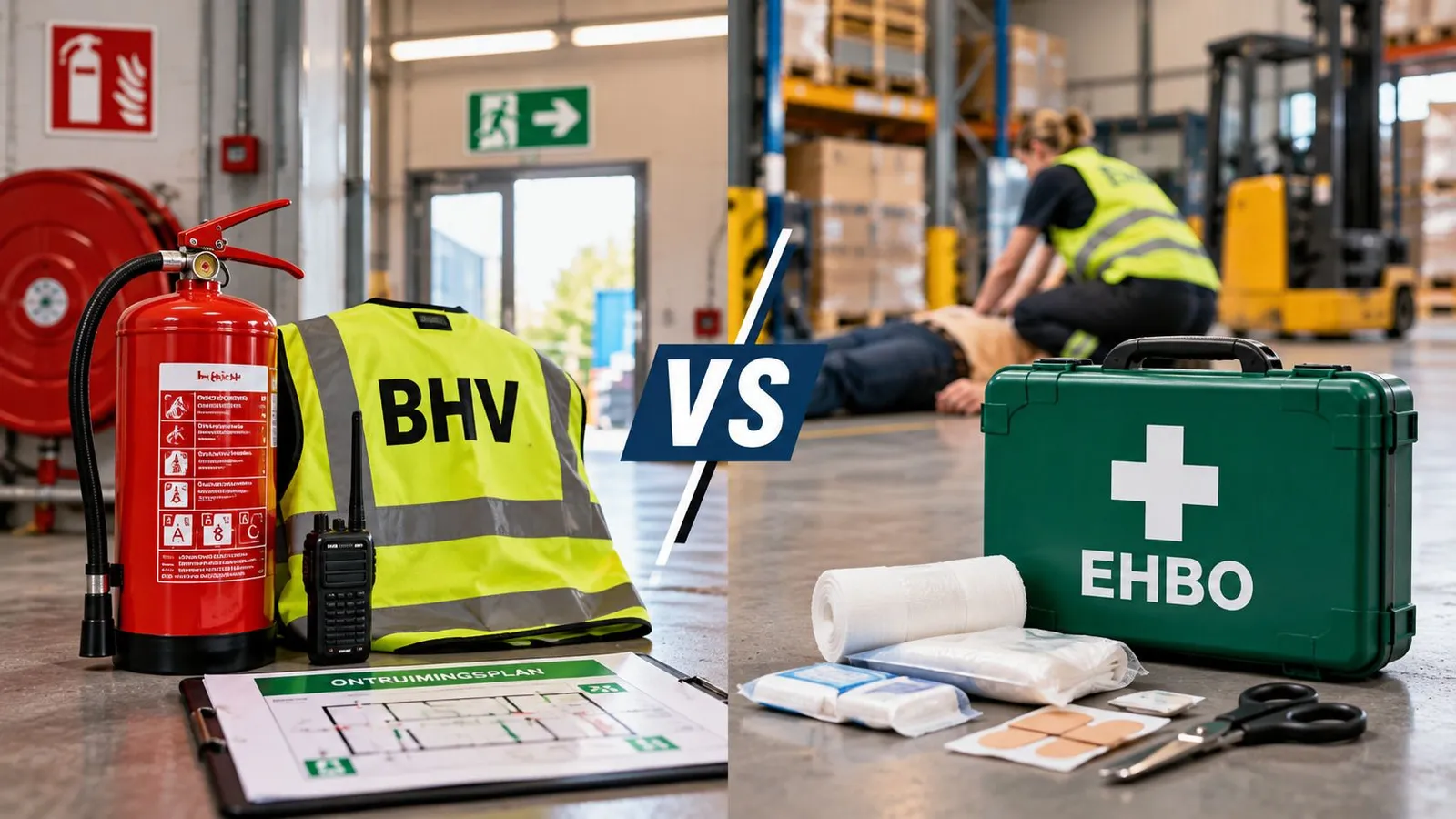
BHV and EHBO are two abbreviations you will quickly come across when working in the Netherlands. Both relate to responding to emergencies, but they do not refer to the same type of training or the same scope of responsibility. BHV prepares employees to respond to emergencies within a company, while EHBO focuses primarily on providing first aid.
BHV stands for the Dutch term bedrijfshulpverlening, which refers to in-house emergency response. A person who performs this role is known as a BHV’er. Their responsibilities are not limited to providing first aid after an accident.
The legal basis for BHV is the Dutch Working Conditions Act – Arbeidsomstandighedenwet, commonly known as the Arbowet. Under Article 15, employers are required to organise bedrijfshulpverlening and appoint one or more employees to carry out BHV duties. The way emergency response is organised should reflect the risks present within the specific company.
BHV covers three main areas:
A BHV’er is therefore someone who should know how to respond during the first few minutes of an emergency before professional emergency services take over. This may involve providing first aid to an injured person, activating an alarm, calling 112, using available firefighting equipment, or directing people towards emergency exits.
EHBO stands for Eerste Hulp Bij Ongelukken, meaning first aid in the event of accidents. Unlike BHV, EHBO training focuses on helping an injured person or someone experiencing a sudden medical emergency.
The exact content depends on the training programme, but participants primarily learn how to assess a situation, respond appropriately to injuries and medical emergencies, and provide assistance until professional emergency services arrive.
This may include:
The key difference is therefore straightforward: EHBO focuses on the individual and providing first aid, while BHV focuses on the safety of the entire organisation during an emergency.
Imagine a fire breaking out in a warehouse. A BHV’er may activate the emergency procedure, assist with evacuating employees, assess the situation in their designated area and – if possible and safe – respond to the initial stage of the fire. If someone is injured during the incident, the BHV’er should also be able to provide first aid to the extent required by their role.
An EHBO’er has a more specialised role focused specifically on helping the injured person. This does not automatically mean that they are responsible for organising an evacuation or dealing with a fire.
BHV and EHBO therefore overlap to some extent, but they are not interchangeable. First aid is one component of BHV, whereas in EHBO it is the main focus of the training. The difference can be remembered as follows:
BHV – first aid + fire response + raising the alarm + evacuation
EHBO – more specialised preparation for providing first aid
This distinction is particularly important for employers. The fact that one person in a company has completed EHBO training does not automatically mean that the company has properly organised BHV in accordance with the requirements of the Arbowet.
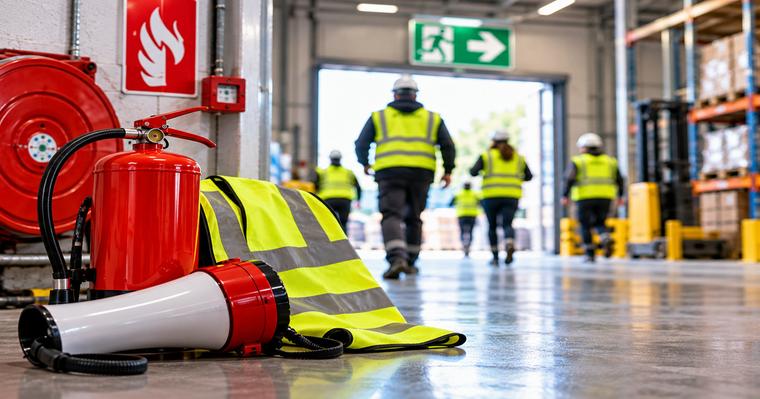
If a company employs staff, the employer is required to organise BHV. However, this does not mean that Dutch regulations prescribe the same number of BHV’ers for every company.
There is no simple rule such as “one BHV’er per 10 employees.” The number of people, the way BHV is organised and the competencies required should be based on the size of the company and the risks identified, among other things, in the RI&E (Risico-Inventarisatie & -Evaluatie). This is the mandatory occupational risk assessment for Dutch companies with employees.
A small office may require different arrangements from a large warehouse, manufacturing facility or construction company. The availability of BHV’ers must also be taken into account. Appointing just one person is of little use if no one is available to perform BHV duties during that person’s holiday, sickness absence or on a particular shift.
Article 15 of the Arbowet also requires those responsible for BHV to have appropriate training, equipment and sufficient numbers to carry out their duties properly. However, the legislation does not prescribe a single government-approved BHV training programme or a statutory frequency for renewing a specific certificate. The level of preparation should correspond to the circumstances and risks within the organisation.
There is no general rule requiring every employee in the Netherlands to hold an EHBO diploma or certificate. EHBO should therefore not be treated as a universal statutory qualification required for every job.
The situation may be different in certain industries, occupations or workplaces where specific regulations or organisational requirements call for particular qualifications. A good example is childcare in the Netherlands. While childcare is being provided, at least one adult with an appropriate recognised paediatric first aid certificate must be present.
In an ordinary company, however, the starting point is different: the employer must organise appropriate emergency assistance and adapt it to the risks present within the company. Employers should therefore first ask themselves: “What types of emergencies could occur in our workplace?” Only then should they decide how many employees need to be trained and what level of training they require.
The responsibilities set out in the regulations are the same, but BHV arrangements should reflect the actual working environment.
In an office, potential emergencies may include sudden cardiac arrest, fainting, fire or the need to evacuate the building efficiently. A BHV’er should know the evacuation routes, assembly point and location of equipment needed in an emergency.
A warehouse involves additional hazards associated with forklift traffic, goods handling, racking systems, loading docks and shift work. In such a company, it is particularly important to ensure that BHV coverage is also available outside standard office hours.
In a manufacturing facility, the risk profile may include machinery, high temperatures, hazardous substances, internal vehicle traffic or specific production processes. General training should therefore be combined with instructions applicable to the specific facility.
On a construction site, the situation is even more dynamic. The stages of work, contractors, access to different areas and types of hazards may change over time. Simply holding a certificate is therefore no substitute for knowing the emergency plan and the rules applicable to the specific project.
Yes. In the Netherlands, an employer can personally perform BHV duties. However, this does not remove the obligation to ensure that emergency response remains available when the employer is absent.
This means that the approach of “the boss is a BHV’er, so everything is covered” may be insufficient. If a company operates two or three shifts or employees are spread across different locations, the organisation of BHV must take these circumstances into account.
The same applies to holidays and sickness absence. This is why many companies train several people, even when the total number of employees might suggest that emergencies could be handled by a smaller team.
If your employer wants to appoint you as a BHV’er, you need training that prepares you for the duties involved in bedrijfshulpverlening. An EHBO course alone does not automatically cover the full scope of BHV because, among other things, it does not provide complete preparation for evacuation and fire-response duties.
If your main objective is to learn how to provide first aid, EHBO training focuses specifically on this area. These skills are useful both at work and in everyday life.
From a company’s perspective, the decision should not begin with choosing the shortest course. The starting point should be the RI&E, the way work is organised and the actual risks involved. A five-person office requires different preparation from a 24-hour logistics centre, while a manufacturing facility will have different requirements again.
For some companies, a sensible solution is to have a BHV team while also developing more advanced first-aid skills among selected employees. This allows employee competencies to be matched to specific risks instead of treating all types of training as equivalent.
For BHV, the regulations require the knowledge and skills of employees appointed to these duties to remain adequate for effective emergency response. However, Dutch regulations do not establish a single statutory rule under which every BHV certificate automatically expires after exactly 12 months.
Regular refresher training and practical exercises are necessary because practical skills can deteriorate over time. Arboportaal highlights the importance of periodically refreshing BHV knowledge and practising emergency procedures. The specific training arrangements should reflect the company’s circumstances and its RI&E.
For EHBO, the validity period of a certificate depends on the specific training system and the organisation issuing the certificate. If an employer requires a particular EHBO qualification, you should therefore check the requirements applicable to that specific document.
This is also important during recruitment. Instead of assuming that every “EHBO” or “BHV” qualification means exactly the same thing, check the name of the course, its scope, the date it was completed and the requirements of the company where you intend to work.
BHV should not end with obtaining a certificate. A trained employee also needs to know where emergency exits, first aid kits and firefighting equipment are located at their workplace, how the alarm is activated, where the assembly point is and how the company’s internal incident reporting procedure works.
The same applies to EHBO. First-aid knowledge is most valuable when an employee is able to apply it under time pressure. This is why practical exercises and regular refresher training are important when preparing a team.
For employers, training a sufficient number of people is also particularly important. The team should be organised in such a way that BHV coverage is available during actual working hours, rather than only when one particular employee happens to be present.
If you want to prepare your employees to provide first aid, check out online EHBO training. It is a convenient way to develop and structure the knowledge needed to respond appropriately in situations involving a threat to someone’s health or life.
If, on the other hand, you are responsible for workplace safety and need to prepare employees to perform BHV duties, Bonapi can train individual employees or entire groups. The training should be tailored to the way your company operates, the number of employees and the risks present in your workplace so that the skills acquired can be applied effectively in real emergency situations.
You can complete EHBO training online and purchase the course directly through the website of our Dutch branch. This allows you to gain the necessary knowledge even before you start working in the Netherlands.
BHV training is available as an in-person course after you arrive in the Netherlands at our Dutch branch in Spijkenisse. This is a practical option for anyone who wants to prepare for the role of a BHV’er in the workplace and develop the necessary practical skills during classroom-based training.
Follow Bonapi on social media or subscribe to our newsletter to receive information about training courses and practical resources on safe working practices in the Netherlands.