User Panel

Training / Courses
Search

Szymon
IT Specialist / Process Automation Specialist

Are you planning to work in the Netherlands or Germany, or collaborate with an industrial company in the Benelux countries, and have come across a requirement for SCC certification? Job advertisements may mention two types of certification: SCC 017 and SCC 018. Although both focus on workplace safety, they are intended for people with different responsibilities and cover different examination topics.
SCC stands for Safety Certificate Contractors, a certification system covering occupational health, safety and environmental protection in work carried out by external contractors. It is primarily used in Germany, as well as Austria and Switzerland, particularly in industrial companies, manufacturing plants and technical service providers. In the Netherlands and Belgium, the equivalent system is VCA.
The SCC system includes requirements for organising work safely, identifying hazards, implementing protective measures and defining the responsibilities of employees and supervisors. An important part of the system involves examinations that verify knowledge of safety procedures among operational workers and those responsible for supervising work.
An SCC certificate may be required by a client even when there is no general legal obligation for all employees to hold one. In practice, companies that use subcontractors often include these requirements in their terms of cooperation or contractual documentation.
You may encounter SCC requirements when working on industrial plant renovations, machinery maintenance, steel structure assembly, electrical installations, welding or construction projects.
It is also important to distinguish between SCC company certification and an individual employee’s certificate. Passing an SCC examination does not automatically mean that the entire company becomes SCC-certified.
The main difference concerns the job role and professional responsibilities of the person taking the examination. The designations 017 and 018 refer to examination documents within the SCC system.
SCC 018 is intended for operational workers, while SCC 017 is designed for managers, supervisors and people responsible for overseeing work.
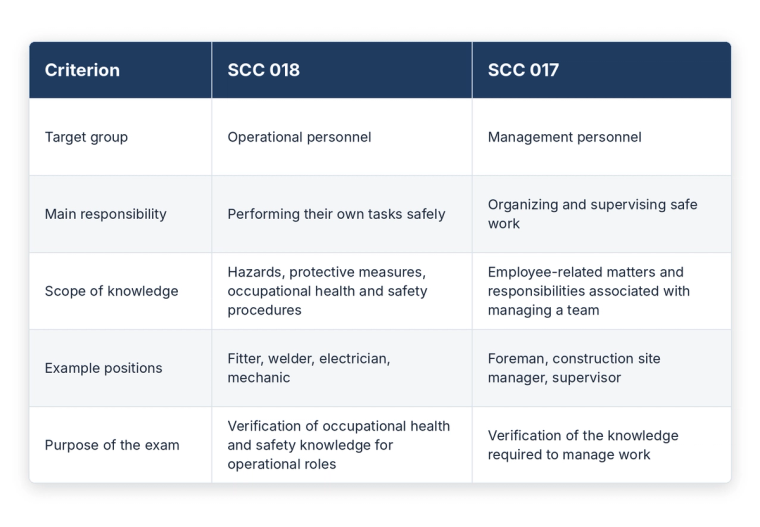
However, you should not choose an examination based solely on your job title. For example, an experienced fitter who independently performs complex tasks does not automatically need SCC 017. If that person organises the work of others and is responsible for supervising them, the requirements may be different.
The deciding factors are your actual responsibilities and the conditions specified by your employer or client.
SCC 018 is designed for people performing operational tasks in environments where occupational hazards are present. This applies to employees hired directly by a company and workers assigned to projects by subcontractors.
SCC 018 certification is commonly mentioned in recruitment requirements for professions such as:
The SCC 018 examination focuses on recognising hazards and understanding how to minimise risks. Candidates should understand why certain activities require protective measures and how to respond to dangerous situations.
The examination covers topics such as safe operation of tools and machinery, electrical hazards, fire protection, working at height, hazardous substances and accident response procedures.
In practice, this means understanding real workplace situations rather than simply memorising definitions. For example, workers should know why damaged power tools must not be used, when work should be stopped and who should be informed about identified hazards.
SCC 017 is intended for people who, in addition to performing their own duties, are responsible for organising the work of other employees. It applies to management and supervisory positions in industrial, technical and construction environments.
This examination may be suitable for foremen, site managers, production supervisors, installation team leaders and people coordinating subcontractors.
Their responsibilities are broader than those of operational workers. Supervisors must understand the hazards associated with specific tasks, but they must also know how to organise work to minimise risks across the entire team.
Important topics include:
For example, a foreman supervising installation work at a chemical plant must consider hazards associated with tools, working at height and operating industrial systems. They must also ensure that tasks are performed by appropriately trained personnel and that hazardous work follows established procedures.
SCC 017 therefore assesses the knowledge required to make decisions affecting the safety of an entire team. However, it does not replace technical qualifications, legally required authorisations or formal appointment to a management position.
Both examinations take the form of a theoretical test. Questions assess knowledge of occupational safety, health and environmental protection, collectively referred to in German as SGU (Sicherheit, Gesundheit und Umweltschutz).
For training courses offered by Bonapi Polska, the examinations have the following requirements:
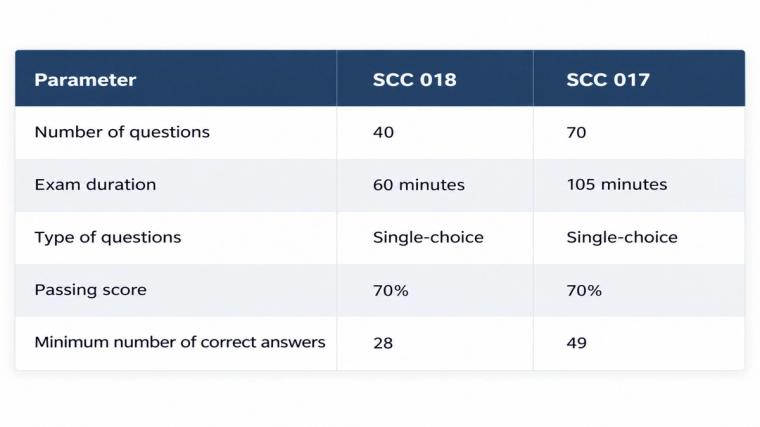
The difference in the number of questions reflects the broader knowledge required of people responsible for supervising employees. SCC 017 includes additional topics related to organising work and ensuring that it is carried out safely.
The examination does not assess practical skills in operating specific machinery or equipment. It does not replace an aerial work platform operator’s qualification, electrical authorisations or other professional certifications. Its purpose is to confirm knowledge of workplace safety requirements.
Before registering, you should also check the examination eligibility requirements. Depending on the applicable certification programme, you may need to provide documents confirming your education, professional experience or relevant training.
Simply attending a course does not always mean that you automatically meet all the certification body’s requirements.
Personal SCC certificates issued under the current SCC-VAZ 2021 system are valid for 5 years. Once this period expires, qualifications must be renewed in accordance with the applicable certification requirements.
An important change also affects older certificates.
Under the previous SCC 2011 system, some certificates were issued with a ten-year validity period. Following the transition to the SGU-Personal VAZ 2021 system, personal certificates issued before 1 November 2021 remain valid only until 31 October 2026 at the latest.
From 1 November 2026, these certificates are no longer recognised, regardless of any later expiry date printed on the document.
If you hold an older SCC 017 or SCC 018 certificate, check its issue date and the certification system under which it was obtained. You may need to retake the examination earlier than the expiry date printed on your certificate suggests.
For companies employing larger teams, maintaining a register of certificate expiry dates is a practical solution. It allows employers to schedule training in advance and avoid problems with employee eligibility for contractual work.
People working abroad frequently encounter both SCC and VCA certification requirements. Both systems address workplace safety and are used in industrial environments, but they operate under different certification frameworks.
SCC is primarily associated with the German market, while VCA is particularly widespread in the Netherlands and Belgium.
The VCA system includes B-VCA certification for operational workers and VOL-VCA certification for people supervising work.
This division is similar to the distinction between SCC 018 and SCC 017, but the certificates are not automatically interchangeable.
Employers may require a specific certificate that complies with the rules applicable to a particular project.
Therefore, holding SCC 018 does not necessarily mean that the certificate will be accepted instead of B-VCA in the Netherlands. Similarly, having VOL-VCA does not automatically satisfy SCC 017 requirements.
If you plan to work in different European markets, check the certification requirements for each contract before choosing a training course.
The easiest way to make the right decision is to analyse your daily responsibilities and whether you are responsible for supervising other employees.
If you work as a welder, fitter, electrician or mechanic and perform tasks according to your supervisor’s instructions, SCC 018 will usually be the appropriate choice.
If you are a foreman, site manager or team leader responsible for organising and supervising the work of others, you should consider SCC 017.
Positions combining operational and supervisory responsibilities require particular attention.
For example, a senior fitter may perform installation work while also assigning tasks to other team members. In this situation, it is important to determine whether their responsibilities require certification at the supervisory level.
A similar situation applies to owners of small subcontracting companies. Simply running a business does not automatically mean that SCC 017 is required. What matters is whether the business owner performs only operational tasks or also supervises other workers.
Before registering for a course, it is best to confirm the required certification level with your employer or client. This will help you avoid obtaining a certificate that does not meet the requirements of a particular contract.
If you are preparing to work in Germany or the Netherlands, you do not have to wait until you move abroad to obtain the necessary qualifications.
Bonapi Polska offers training courses preparing candidates for SCC 017 and SCC 018 examinations at its training centre at 16 Św. Urbana Street in Gliwice, Poland.
The courses are designed for both individuals and companies looking to prepare their employees for demanding industrial projects.
During training, participants learn about occupational safety, health and environmental protection while preparing for the examination appropriate to their professional responsibilities.
For companies, the opportunity to organise training for entire teams is particularly valuable. It allows employers to prepare both operational workers and supervisors for contracts requiring verified knowledge of SCC safety standards.
Explore the SCC 017 and SCC 018 training courses available at Bonapi Gliwice and choose the programme that matches your employees’ responsibilities.
You can also explore the individual SCC 017 course for managers and supervisors or the SCC 018 course for operational workers.
Follow Bonapi on social media to stay informed about upcoming training dates, available courses and certification requirements for working abroad.