User Panel

Training / Courses
Search

Szymon
IT Specialist / Process Automation Specialist
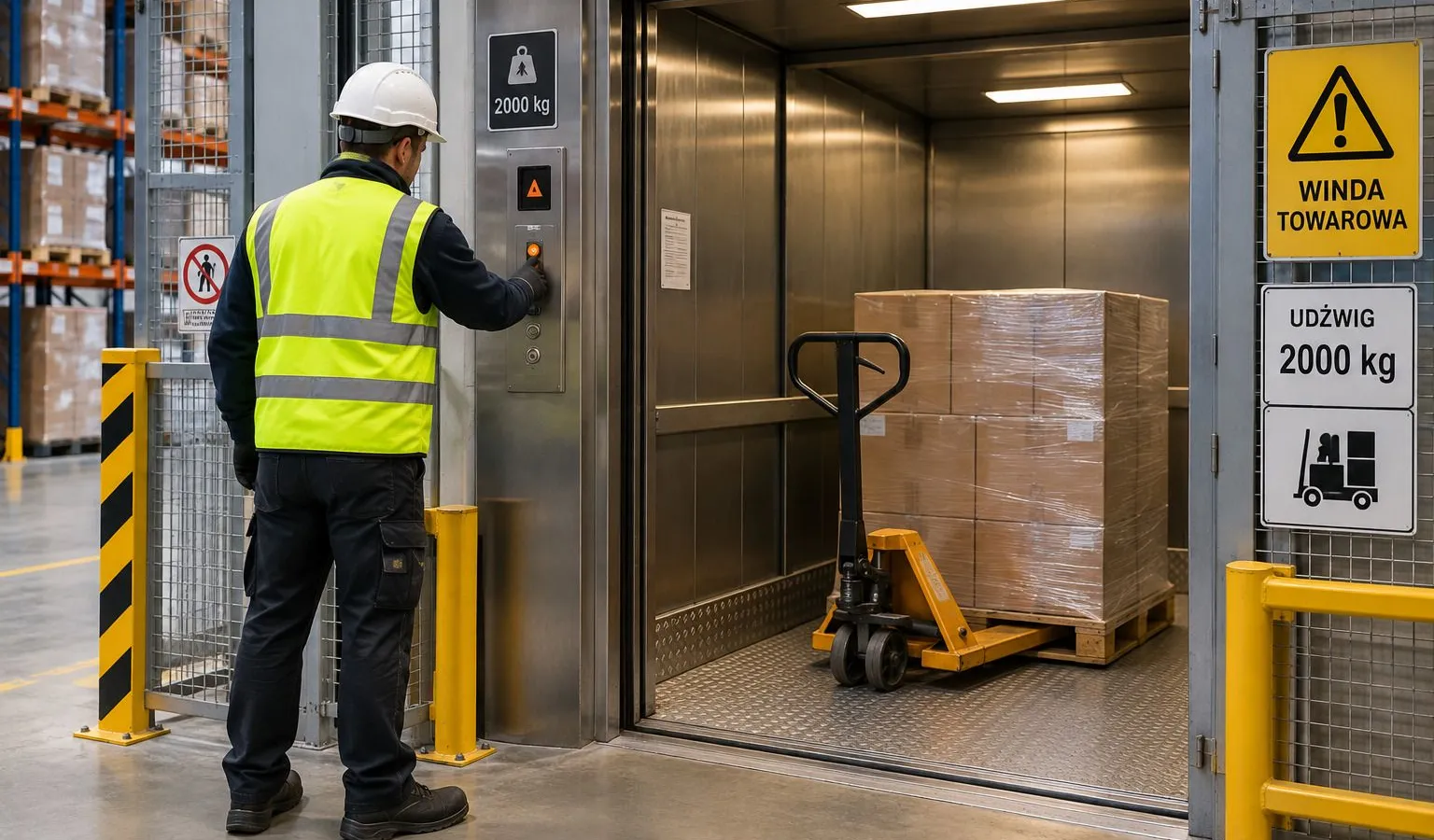
Goods lifts are widely used in warehouses, manufacturing plants, logistics centres, wholesale facilities and commercial buildings. They make it easier to transport heavy loads between floors, reduce the need for manual handling and improve everyday operations. However, operating a goods lift may involve specific employee qualification requirements. Do you need UDT certification to operate this type of equipment?
A goods lift, technically classified as a freight lift, is a device designed to transport loads vertically or along a guided path between designated levels. Depending on its design, it may be intended exclusively for transporting goods or may also be suitable for carrying passengers.
These devices are used across many industries. They vary in load capacity, cabin or platform dimensions, loading methods and control systems.
They are most commonly found in the following locations:
However, not all goods lifts operate in the same way. A small dumbwaiter used to transport meals has a different design and operating procedure from a large warehouse lift capable of accommodating a pallet truck.
For this reason, it cannot automatically be assumed that all devices commonly referred to as goods lifts require the same operator qualifications.
In Poland, technical inspection requirements are regulated by the Act of 21 December 2000 on Technical Inspection and the regulations issued under it. For lifts, the regulations governing the qualifications of personnel responsible for operating and maintaining technical equipment are also particularly important.
The main legal act in this area is the Regulation of the Minister of Entrepreneurship and Technology of 21 May 2019 on the procedures for verifying qualifications required for the operation and maintenance of technical equipment and for extending the validity of qualification certificates.
The key distinction is between two separate issues: whether the equipment is subject to technical inspection and whether the person operating it must hold a qualification certificate issued by UDT (Urząd Dozoru Technicznego, the Polish Office of Technical Inspection).
The fact that a lift is subject to technical inspection does not automatically mean that every employee using it must pass an examination conducted by a UDT examination board.
The list of equipment requiring operator qualifications includes, among others, construction hoists, goods and passenger lifts with internal controls, and hospital lifts. However, this does not mean that every device described as a goods lift falls into one of these categories.
It is therefore necessary to establish:
If the equipment does not fall into a category requiring a UDT operator qualification certificate, employees must still receive appropriate training to use it safely.
The absence of a UDT certification requirement does not mean that the equipment can be operated without proper instruction.
The term “goods lift” is relatively broad and covers equipment with different designs and purposes. Correctly identifying the type of lift is important both for workplace safety and for determining the employer’s legal obligations.
Goods lifts are designed to transport loads between designated levels of a building. They may have an enclosed cabin, a platform or another structure suitable for moving goods.
One example is a warehouse lift used to transport pallets between the ground floor and an upper floor. An employee places the load inside the lift, leaves the transport area and activates the appropriate control function in accordance with the operating instructions.
For such equipment, its classification must be verified. Not every goods lift requires the operator to hold a separate UDT qualification certificate.
Goods and passenger lifts are designed to transport both loads and people, provided this is permitted by the manufacturer.
The control system is particularly important in this category. The regulations on operator qualifications specifically include goods and passenger lifts with internal controls. Operating equipment classified in this category requires an appropriate qualification certificate.
However, not every goods and passenger lift should be treated in the same way as a conventional passenger lift that building occupants operate independently.
Small goods lifts are also used in restaurants, hotels and service facilities to transport items such as meals, documents and lightweight materials.
They are usually operated from outside the lift at a landing and are not intended to carry passengers. The requirements for their users may therefore differ from those applicable to construction hoist operators.
However, the need for qualifications is determined by the equipment’s classification under its technical documentation and applicable regulations, not simply by its size.
Employers are responsible for organising work safely and ensuring that equipment used by employees is in proper working condition and operated according to its intended purpose.
For goods lifts subject to technical inspection, additional obligations arise from the regulations governing the operation of lifting and handling equipment.
Detailed requirements are set out in the Regulation of the Minister of Entrepreneurship and Technology of 30 October 2018 on the technical inspection requirements for the operation, repair and modernisation of lifting and handling equipment.
The operator organisation’s main responsibilities include:
It is important to distinguish between the responsibilities of an operator and those of a maintenance technician.
An employee operating a goods lift should not independently interfere with its mechanisms, safety systems or control installations. Such work must be carried out by individuals with the appropriate qualifications and authorisations.
Operating a goods lift may seem straightforward, especially when the task involves placing a load inside the cabin and pressing a button.
However, an operator or trained user must monitor several important factors that affect transport safety.
Before starting work, employees should familiarise themselves with the equipment’s operating instructions and inspect its condition within the scope of their responsibilities.
Particular attention should be paid to the condition of the doors, visible damage, control system messages and correct equipment operation.
The following rules must be observed when transporting loads:
For example, a warehouse employee may use a goods lift to transport a loaded pallet to an upper level.
In this situation, the employee must consider not only the maximum permitted weight but also the dimensions and stability of the load.
Incorrect pallet positioning may damage the cabin, doors or transported goods. Attempting to transport a load that exceeds the lift’s rated capacity can also create a serious safety hazard.
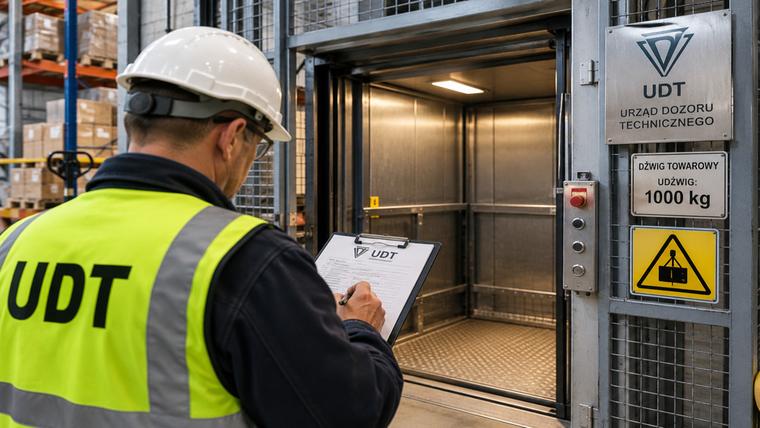
If a particular type of equipment requires a qualification certificate, the candidate must pass an examination conducted by an examination board of the relevant technical inspection authority.
Completing a training course alone does not replace the required examination.
The qualification process usually involves several stages.
Before starting training, you must determine which qualifications are required to operate the specific type of lift.
Candidates learn about the equipment’s operating principles, safety requirements, operator responsibilities and appropriate responses to equipment failures.
Participants practise equipment inspections, correct load handling and operating procedures in accordance with the manufacturer’s instructions.
The examination is conducted as part of the qualification assessment procedure administered by the relevant technical inspection authority.
After successfully completing both parts of the examination, the candidate receives a qualification certificate covering the relevant equipment category.
For construction hoists, goods and passenger lifts with internal controls, and hospital lifts covered by the relevant qualification categories, the certificate is valid for 10 years.
Before the certificate expires, its validity may be extended under the conditions specified in the regulations.
Applicants must meet the applicable requirements, including those relating to performing work within the scope of their existing qualifications.
Yes. Even if a particular lift does not require its users to hold a UDT qualification certificate, the employer must still ensure that employees are properly prepared to operate it safely.
This obligation follows, among other provisions, from Article 237³ of the Polish Labour Code, which establishes employers’ responsibilities regarding occupational health and safety training.
Workstation-specific training should address the hazards associated with the equipment being used.
For goods lifts, employees must also be familiar with the operating instructions for the specific model.
Practical training may include:
This type of training is particularly valuable in companies where multiple employees use the same lift across different shifts.
Standardising operating procedures helps reduce mistakes and minimise the risk of equipment damage.
If you run a manufacturing, warehousing, construction or logistics company and want to ensure your team has the necessary qualifications, explore the training programmes offered by Bonapi in Gliwice.
We organise training courses for individual employees and corporate groups.
Our training programmes include a goods lift operator course, which provides both theoretical knowledge and practical preparation for safe equipment operation.
We also offer courses designed to prepare participants for UDT examinations covering selected categories of lifting and handling equipment.
Explore the UDT training programmes and equipment operator courses available at Bonapi Gliwice, and contact us to choose the right training programme for your employees.
We can train individual employees or entire teams, tailoring the training to your company’s specific needs.
Proper employee training helps ensure safe working conditions and compliance with the requirements governing equipment operation.
Follow Bonapi on social media to stay informed about upcoming training dates, vocational courses and opportunities to gain new professional qualifications.