User Panel

Search

Szymon
IT Specialist / Process Automation Specialist
The VCA examination system was updated substantially in 2026. If you are preparing for B-VCA or VOL-VCA, or if you organise training for employees, the key point is to use learning materials that match the current Eind- en Toetstermen (ETT). From 1 September 2026, ETT 3.1 is the current reference.
This does not mean that VCA has become a completely different qualification. The update mainly modernises terminology, makes examples less petrochemical-specific and places more emphasis on practical safe behaviour. For candidates, however, outdated test banks can create unnecessary confusion.
ETT describes the knowledge and examination requirements for VCA candidates. SSVV, the Dutch organisation responsible for the VCA system, updates these requirements when safety practice or examination standards change.
The 2026 rollout started with ETT 3.0 for renewed Dutch-language exams. Other languages followed during the year. From 1 September, ETT 3.1 documents and test matrices apply, including an updated modular B-VCA structure used in education.

One of the clearest changes concerns VOL-VCA and VIL-VCU. The renewed exams contain 60 questions instead of 70, with a standard examination time of 60 minutes instead of 75. The regular B-VCA exam continues to contain 40 questions.
The content is also more practice-oriented. Candidates can expect clearer references to safe work agreements, LMRA, risk-control measures and situations in which a separate specialist qualification is required. The intention is to test whether a worker understands safe decisions rather than remembers old branch-specific wording.
The modular B-VCA exam also has a revised distribution of subjects across its four modules. Previously passed modules remain valid under the transition rules.
Yes. A valid B-VCA or VOL-VCA diploma does not expire because the exam content has been updated. VCA personal diplomas remain valid for ten years from the examination date.

Use current course material and avoid relying only on old online test questions. Understand the reasoning behind safe decisions, practise the current exam format and pay attention to terminology around LMRA, safe behaviour and work organisation.
B-VCA is generally intended for operational workers. VOL-VCA is designed for operational supervisors and other roles with responsibility for organising and supervising work. The correct choice should follow the role and the client’s requirements, not simply the idea that VOL is “better”.
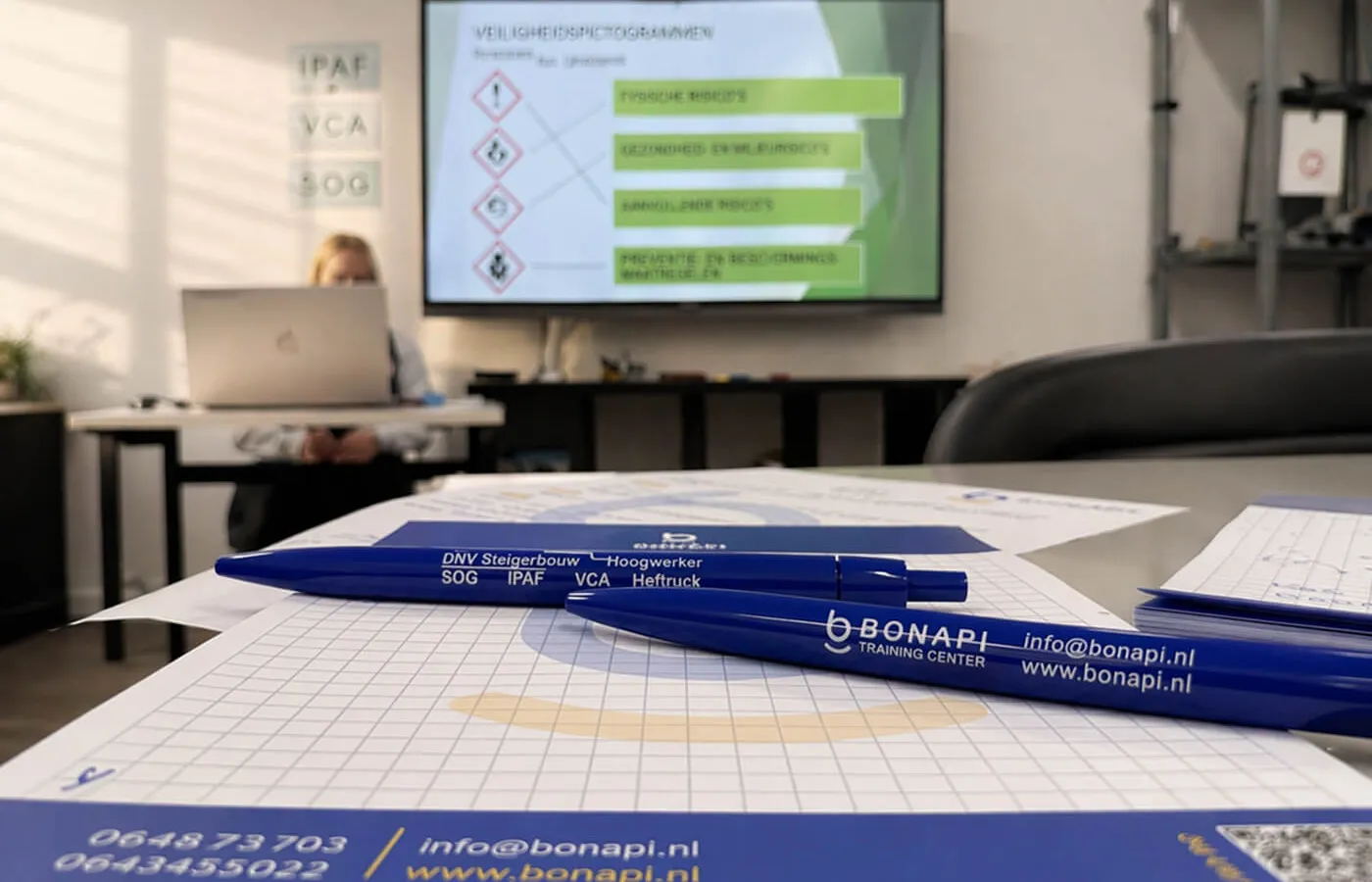
Bonapi Poland offers VCA training and official examinations at its training centre at Św. Urbana 16 in Gliwice. Candidates can choose a classroom route or online learning followed by an on-site examination.
For the current Polish B-VCA option, Bonapi lists 40 questions and a 65% pass threshold. After a pass, the diploma is recorded in the SSVV Central Diploma Register and remains valid for ten years.
VCA is not simply a collection of rules to memorise. Candidates are expected to recognise a hazard, understand the risk and choose an appropriate control measure. Typical subjects include workplace organisation, personal protective equipment, tools and machinery, electrical safety, hazardous substances, fire prevention, work at height, lifting and moving loads, emergency response and the responsibilities of employees. LMRA, the last-minute risk assessment carried out before starting a task, is also an important part of the safety mindset behind VCA.
A useful course therefore does more than reveal correct answers. It explains why one option is safer than another and uses realistic situations from construction, industry and logistics. This helps candidates with unfamiliar questions and makes the qualification more useful once they arrive on site.
The first mistake is relying only on old practice tests. A question may look familiar while the terminology or context has changed. The second is reading too quickly. Words such as “first”, “best” or “safest” can change what the examiner is asking for. The third is choosing PPE immediately without considering whether the hazard can first be removed, isolated or otherwise controlled.
Another frequent problem is taking the exam in a language the candidate does not fully understand. Technical safety wording can be difficult even for experienced workers. Choosing the strongest available language usually gives a fairer measure of the candidate’s safety knowledge.

B-VCA is available in multiple languages. Bonapi lists Polish, English, Ukrainian and a range of other options, subject to the selected date and exam availability. Working in the Netherlands does not mean that the exam has to be taken in Dutch. The best language is normally the one in which the candidate can understand safety concepts without translating every sentence mentally.
Employers should separate two issues: new training and existing diplomas. New candidates should prepare with current SSVV-aligned materials. Employees who already hold a valid diploma do not need a replacement merely because ETT has changed. Instead, companies should monitor expiry dates in the CDR and schedule renewal early enough to avoid a project delay.
A simple competence register can save a lot of administration. Record each employee’s role, VCA level, verification status and expiry date. Before a new project, compare that list with the client’s requirements rather than discovering missing qualifications at the gate.
Seven days before the exam, check that the course material is current and identify weak subjects rather than repeating everything from the beginning. Two or three days before, complete a realistic practice test without looking at notes and review only the questions you misunderstood. On the final day, focus on terminology and rest. This approach is more effective than doing dozens of random old tests, because it shows whether the candidate understands the safety logic behind the answer.