


User Panel
UDT
The UDT exam in practice. What mistakes should a prospective operator avoid?

Szymon
IT Specialist / Process Automation Specialist
Many years’ experience of operating a forklift truck or aerial work platform does not always mean that the UDT examination will be a mere formality. An operator may carry out their day-to-day duties efficiently, yet still struggle to explain the principles of the machine’s stability, assess its technical condition or correctly perform the tasks required during the examination.
Why is this the case? Because the examination tests not only the ability to operate the machine, but also knowledge of the principles of its safe operation.
The UDT test involves more than just driving along a set route
The UDT qualification examination consists of a theoretical and a practical part. In the case of material handling equipment, the scope of the skills assessed depends on the type of equipment and the qualification for which the candidate is applying.
During the practical forklift truck examination, the tasks assessed include, amongst other things, those relating to the preparation of the equipment, its safe operation and the handling of loads.
In the case of mobile aerial work platforms, the ability to prepare the machine correctly, control the platform’s movements and manoeuvre safely is also essential.
It is therefore not enough simply to demonstrate that we can start the equipment. We must show that we understand how it should be operated.
Failing to check the equipment before starting work
One of the mistakes to be particularly wary of is a superficial approach to machine inspections.
An operator accustomed to using the same equipment on a daily basis may treat checking its technical condition as a routine task to which they pay little attention.
However, before commencing operation, the relevant inspection procedures must be carried out in accordance with the equipment’s manual.
In the case of a forklift truck, the condition of the forks, mast, tyres, control system and warning devices, amongst other things, is important.
With an aerial work platform, additional elements to check include the work platform, safety railings, lifting mechanisms and emergency systems.
The inspection has a specific purpose: to detect any faults before the equipment is put into operation.
Performing manoeuvres too quickly
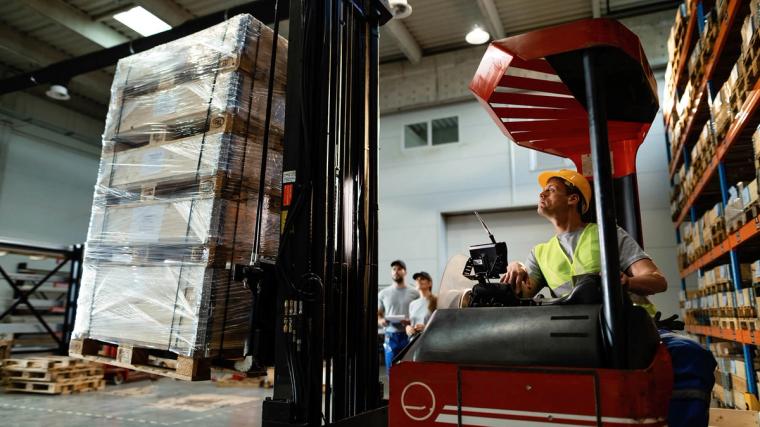
Experienced operators are often able to carry out tasks much more quickly than beginners. However, this does not mean that the main focus during the test should be on demonstrating speed.
Abrupt turns, unnecessary acceleration or imprecise positioning of the machine can make it more difficult to carry out the task and increase the risk.
In the case of forklift trucks, it is particularly important to pick up and set down loads correctly and to maintain the correct fork position whilst driving.
With aerial work platforms, the movements of the platform should be smooth, controlled and adapted to the surrounding conditions.
The test is not a competition to see who can perform a manoeuvre the fastest. It is far more important to carry it out safely and in accordance with the requirements.
Failure to observe one’s surroundings properly
When operating the equipment, the operator is responsible not only for the machine itself, but also for the safety of people in its vicinity.
In the case of forklift trucks, restricted visibility, the movement of loads and the presence of pedestrians are of particular importance.
The operator should monitor the direction of travel, check the available space and react appropriately to obstacles.
In the case of aerial work platforms, it is also important to take into account the height, structural elements and the space required to manoeuvre the boom.
Focusing attention solely on the controls can lead to overlooking hazards in the vicinity of the machine.
Practical knowledge without an understanding of the theory
People with professional experience sometimes assume that, since they know how to operate a machine, they do not need any theoretical training.
However, the day-to-day operation of a machine does not always require consciously recalling all the principles on which its safe operation is based.
One example is the stability of a forklift truck. The operator should understand why the permissible load capacity depends, amongst other things, on the position of the load’s centre of gravity and the lifting height.
Similarly, with aerial work platforms, it is essential to be familiar with the limitations of the specific machine, ground conditions and the procedures to follow in emergency situations.
Theory is not merely an add-on to practice. It enables one to understand the consequences of the manoeuvres being carried out.

How do you prepare for the UDT exam?
Preparation should include both a revision of theoretical topics and practical exercises.
It is worth paying attention to the procedures to be carried out before starting the equipment, the rules for safe operation, and the correct procedure for finishing the operation.
Mock tests are also helpful for checking your knowledge of the exam topics.
The Bonapi website offers free mock tests covering, amongst other things, UDT forklift trucks and UDT aerial work platforms. These serve as an additional learning tool but are no substitute for practical preparation.
Bonapi Polska runs training courses in Gliwice to prepare candidates for UDT exams. The courses cover both theory and practical exercises on the equipment.
It is worth remembering that the aim of proper preparation is not merely to pass the exam. The most important thing is to acquire the skills needed to operate the machinery safely, even after obtaining the licence.